An engineer’s working arrangements depend on their discipline. Software jobs often use shared digital tools. Manufacturing jobs often require working with physical parts.
Remote engineering work depends on the task. A design revision may be completed off-site, while equipment changes need onsite support. Programmable logic controls (PLC) can combine remote development time with onsite installation.

This guide covers the hiring process, including sourcing, screening, assessment, and onboarding. It starts with the part that decides everything else: working out how much of the role is genuinely remote before you advertise a remote engineering job.
Summary
Below, I list what hiring remote engineers involves:
- Split the role by percentages before you post it. Something like this; design, simulation, offline programming, documentation, project management, travel time, onsite installation, safety inspection, and equipment buyoff.
- Decide the employment model early. Will you use a full-time employee, independent contractor, or temporary engineering staffing agency to carry out different project tasks? That choice changes which candidates you can approach.
- Screen for remote working ability alongside the person’s technical skills. Written communication, self-motivation, and experience working independently all matter, and traditional technical face-to-face interviews may not reveal this.
- Assess work that resembles the job. A short, day-to-week paid project and a conversation with the engineers they will work alongside surface things a standardized technical interview can miss.
- JOINER Services uses engineering contractors available for remote and onsite work, covering both halves of the problem.
Which Engineering Work Can Actually Be Done Remotely?
Most advice on this subject assumes engineering means software or design. In manufacturing and industrial settings, that assumption falls apart quickly, so it is worth being precise about your job description.
The split runs along tasks, not necessarily the job titles. Industrial automation engineering roles often combine remote and onsite tasks. Define which parts of the scope require physical presence before choosing the working arrangement.
Work that can be done remotely:
A large share of engineering output is a file, a drawing, a program, or a decision. None of that requires proximity to an actual machine.
- Design engineering and computer-aided design (CAD): models, drawings, tolerance work, and revisions.
- Simulation and analysis: finite element analysis (FEA), thermal and flow modeling, and tolerance stack-ups.
- Offline programming: robot paths built and validated in simulation before they reach the cell.
- Controls and software development: PLC code, human-machine interface (HMI) screens, and the software, information technology, and industrial internet of things work that sits alongside them.
- Technical documentation: procedures, work instructions, validation packages, and quality records.
- Project and program management: schedules, vendor coordination, and reporting.
Work that needs someone to be hands-on at the equipment:
Work that is physically tied to the asset.
- Installation and mechanical integration: equipment set, aligned, and connected.
- Welding inspection and procedure qualification: the judgment calls that need eyes and hands on the workpiece.
- Machine run-off and acceptance testing: verifying performance in front of the people paying for it.
- Final equipment checks: the physical verification before a line is handed over.
Commissioning and troubleshooting can sit between the two. Remote commissioning support and remote fault diagnosis are established practice, with an engineer working through a PLC or HMI connection while a local team handles anything onsite.
What still needs someone at the equipment is the hands-on work that industrial installation support covers: wiring changes, mechanical adjustments, and physical checks before the system is accepted.
When engineers work remotely part of the time:
The interesting roles are the hybrid ones, and hiring decisions often go wrong there. A contract controls engineer may spend six weeks writing and simulating code from home, then two weeks on site for installation. A design engineer may work remotely until the prototype build, then need to be in the room for the build with other engineers.
Treating these as fully remote roles leads to an awkward conversation later about travel support that was never discussed. Define the split in the job description. Say how many weeks are remote, how many are onsite, and who pays for travel. An engineer who agreed to remote work and then discovers three months a year of travel is an engineer who will end up leaving.
Why Remote Engineering Roles Are Worth It?
Two forces pull in the same direction here, and understanding both helps you write a description for a job people want.
For companies, the national reach is the point. Hiring remotely opens the positions to a massive talent pool instead of one within a commuting radius. This matters most when the discipline is extremely niche, and the nearest qualified person is three hours away.
Companies that bring in remote workers who have solved similar problems in other industries and regions. That perspective is often more valuable than needing someone onsite. Building a remote team widens the company’s knowledge in a way a local search cannot.
Cost savings follow, since remote roles carry no office space and often draw candidates will to take a reduced rate to work-from-home. Specialized engineering talent rarely comes cheap wherever it sits, so treat savings as an extra bonus to finding great talent and not the main reason.
For engineers, the draw is usually better work-life balance and the ability to choose where they live. Remote jobs also let experienced people work for established companies without relocating, which widens the field of senior engineers willing to consider a role.
The catch is that remote work suits some engineers better than others, so be cautious of when to hire that role.

How To Hire Remote Engineers Step By Step.
Eight steps, in the order they need to happen. The early ones decide the quality of everything after them.
1. Define the role, the overlap, and the travel
Write down what the engineer will be responsible for, which tools and platforms they will use, and what a successful deliverable looks like. Specify the working-time overlap needed with your existing team, expected site visits, and travel arrangements. Include any restrictions on where the engineer may work.
Be specific about the technical expertise involved as well. Describe the technical expertise required through specific technical skills, equipment, and deliverables. Decide how much shared working time the role needs based on how tightly the team coordinates work together.
2. Choose the employment model
Employee, independent contractor, and temporary staffing agencies can each suit different situations, and the choice narrows your candidate pool before you post anything.
A direct hire suits ongoing work with no defined end. A project with a defined scope and finish date may point toward an independent contractor, and a dedicated team of contractors suits much larger staffing needs.
3. Decide where to look beyond job boards
Where you search depends on the discipline, and this is where remote advice stops being useful.
Remote job boards are built around specific roles, so one could be filled with software developers and thin on controls or weld engineers. If you use the right board, it can be a reliable way to find engineers or a terrible decision if you don’t have a defined project.
For industrial disciplines, specialist engineering job boards and referrals from people in the field beat a wide net.
Specialized engineering talent is hard to reach through general job boards, so a posting could attract fifty software applicants, but maybe none are an actual good fit for the role. On big boards, sometimes searching for availability tends to work better than waiting for applicants to apply to the role.
The remote talent in a narrow discipline is a smaller group than the tech talent pool software teams draw on, and the top remote talent in any field is usually mid-project. Expect to approach remote candidates instead of collecting them.
When finding engineering contractors, look at what each source can actually show you. A profile that lists technical skills, verified experience, and current availability saves a screening round that a resume does not.
Hiring for a discipline where the pool is small? JOINER Services lets you search screened engineering contractors by technical skills, experience, location, and availability, which matters most when the role is specialized.
4. Screen for remote work ability
Assess technical ability alongside communication skills and other soft skills needed for independent work. Strong technical performance alone does not establish readiness for remote work.
Screen for it deliberately. Ask how they structure a day without a manager nearby, how they handle being stuck when the person who can support them is not in the office, and what their remote setup looks like.
Written communication deserves particular attention in a remote setting. Ask a structured question by email and read the reply for clarity and completeness.
5. Run an assessment that resembles the job
A practical assignment can reveal things a traditional interview misses, particularly documentation habits and how someone works without being watched.
Use a short, paid exercise built from real work. A small design revision, a section of PLC logic, a simulation to set up, or a procedure to write shows judgment and documentation quality. It also shows how someone handles a brief with gaps.
Keep it to a few hours and pay for it. An unpaid take-home that eats a weekend filters out the experienced engineers you most want, since they have other options.
For contract work, a short first assignment serves the same purpose as a trial period. Start with well-defined tasks before handing over complex projects, and both sides learn what they need to know.
6. Interview with your engineering team
Include a qualified technical reviewer early. Recruiter and hiring-manager interviews should complement, not replace, a discussion of the actual engineering work.
In smaller companies, that technical voice is often the manager or senior engineer. Whoever on your engineering team will depend on this person should be in the loop, along with the project managers whose schedules the work affects.
Use a realistic task with the kind of ambiguity the job actually contains, then watch how the candidate asks for clarification. How someone handles an incomplete brief is one useful indicator of how they will work when the team is offline.
In a remote setting, ask candidates to explain a technical decision in writing. Assess clarity, completeness, and whether they identify missing information.
7. Check references and finalize the agreement
Speak with former clients, project leads, or managers who have worked directly with the engineer. Ask about technical performance, independence, communication, and whether they would work with the person again.
Self-employed engineers often have clients instead of managers, so the right reference is whoever can speak to the work.
Then finalize the engagement before work begins. Confirm compensation, payment terms, confidentiality, and ownership of the work produced, and put travel expectations and expenses in writing for any hybrid role.
If the engineer is working from another state or country, check the applicable employment, tax, and intellectual property requirements before you sign.
8. Onboard for remote work
Communication helps teams coordinate when working hours do not overlap. Remote onboarding needs explicit instructions, accessible documentation, and named contacts.
Give them system access that works on day one, the documents and drawings they need, a named contact for technical questions, and the escalation path if anything stops. Write down the communication outreach order instead of letting them find out on their own.
Remote collaboration improves when you document decisions. Company culture reaches remote employees through both written guidance and regular interaction.
For controls, automation, or other industrial work, confirm how the engineer will securely access the systems they need. Coordinate remote connections with your information technology (IT) and onsite plant teams, restrict access to the project, and agree on who approves changes to live equipment.
Confirm who provides the software licenses and engineering tools before the start date. A contract design engineer who cannot open your CAD files, or a controls engineer without a license for your PLC programming environment, loses the first week to onboarding, is not a good use of their time.
Set a first deliverable inside the first two weeks. Nothing clarifies a remote working relationship faster than a piece of finished work to review together and set yours and the company expectations.

Mistakes That Sink Remote Engineering Hires
Some remote engineering hires go wrong before the first interview even happens, and the hiring process is usually where the damage is done.
- Advertising a hybrid role as fully remote: The engineer finds out about the travel after accepting, and the arrangement sours over something that was never a disagreement about the work.
- Hiring on technical skills alone: A strong engineer who needs direction in the room will struggle in a remote environment, and that is a working-style mismatch, not a competence problem.
- Testing for the wrong thing: Live problem-solving under observation tells you less about the worker than written communication and documented output do.
- Ignoring time zones until after the offer: Overlap is a structural constraint on how the team works, and discovering it late means rebuilding working patterns around one person.
- Treating worker classifications differently: Whether someone is an employee or a contractor, the work load should not differ too much, as the same tools and standardized practices should continue to take place.
Hire Remote And Onsite Engineers With JOINER Services
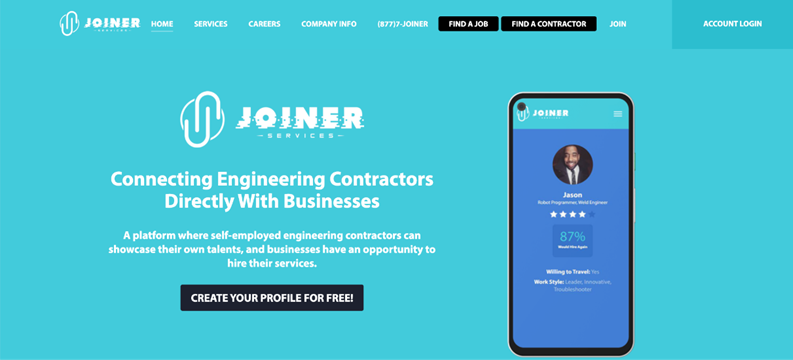
JOINER Services provides remote, hybrid, and onsite engineers! They connect businesses directly with engineering contractors. Every contractor clears an onboarding process covering reference checks, educational verification, and screening interviews.
You search profiles by technical skills, experience, job title, location, and availability, then contact the engineers who fit. For contractors who have completed projects through the platform, profiles also carry client-confirmed technical skills and ratings from the company that hired them last.
Its remote temporary staffing support spans software, information technology (IT), and industrial internet of things (IIoT), along with controls (PLC), electrical and mechanical design, and program managers.
Have a project where some of the work can be done onsite and some of it cannot? Create a free business account and filter for engineers.
Find Engineers for Your Project →
FREQUENTLY ASKED QUESTIONS:
Below, I list some FAQs about how to hire remote engineers.