Engineering talent solutions is a large category name in the staffing realm, but it could also be a product. Under that label sit hourly contractors, permanent job searches, outsourced projects, and hiring full-time engineers, which have four completely different outcomes. Plus, when you include hiring software that these companies use, it’s a whole other list of talent “solutions.”

The marketing on company websites rarely separates them. Service pages and blog posts in the category promise a trusted partner with a deep understanding of your industry.
The distinction of these “solutions” matters, because the wrong category wastes weeks or months of your time. Engineering recruitment is the right answer for a permanent engineering manager role and the wrong one for help on a production line today.
This guide sorts engineering talent solutions into two key categories of what they actually are: professional services that supply people, and software that manages the hiring process. Each entry covers how it works, what it costs you in time and/or money, and the situation it genuinely fits.
Summary
- Engineering talent solutions fall into two families: services that supply people, and software that organizes the hiring you already run. The label alone never tells you which one a vendor sells.
- Contract staffing, contract-to-hire, and direct hire recruiting cover most hiring needs. The deciding questions are whether the work has an end date and how much of the searching you want to do yourself.
- Outsourced delivery under a statement of work (SOW) buys a finished result rather than people, while recruitment process outsourcing (RPO) and managed service provider (MSP) programs take over continuous hiring.
- Hiring software, from applicant tracking to sourcing tools, vendor management systems, and skills assessments, tightens the process but never finds an engineer, so it supplements a provider instead of replacing one.
- JOINER Services lets you search self-employed engineering contractors by skills, availability, and past client feedback, then choose the individual for your project.
Staffing Services Or Staffing Software: The First Decision To Make!
Everything on that list falls into one of two groups.
An engineering staffing agency or a search firm does the finding, and you get engineering professionals on site. They differ in how they source that technical talent. Some present engineering candidates from a database they already hold, and some run a fresh search for every role.
Contractor platforms sit between the two types of staffing services. Their technology connects you with engineers directly, but the searching, shortlisting, and interviewing stay with you rather than a recruiter.
Software solutions organize the work you already do. An applicant tracking system does not find a chemical engineer, it only keeps track of the ones who applied for the role.
Most engineering teams end up combining categories, so it helps to know what each one is before comparing vendors of engineering staffing solutions. The order matters. Software pays off when you hire steadily and want the process tighter, while services pay off when you have a gap now and no pipeline to draw from.
Service Solutions: Getting People On The Project
Below, I list the six ways to get an engineer working on your project, running from the shortest time commitment to the most involved.
Contract Staffing:
A temporary staffing agency employs the engineer and assigns them to your project. You pay an hourly bill rate covering pay, insurance, overhead, and markup, and the engagement ends when the work does.
This is the workhorse of engineering staffing, and it covers most short-term gaps: leave coverage, a commissioning window, a backlog of drawings that needs two mechanical engineers, or the six months between funding a project and finishing it.
It also keeps critical projects moving when a project engineer resigns mid-build, or when a build takes a new direction and needs support the existing team cannot cover.
The trade-off is cost per hour against commitment. Hourly bill rates are considerably higher than comparable employee pay because they include employment costs, insurance, overhead, and agency markup.
What you avoid is the administration and the obligation. The agency carries the employment relationship, and nothing continues once the project closes. Ask what sits inside the rate before comparing contract staffing services quotes, since markups are rarely itemized.
Use it when: The work has an end date, its temporary work, or you need skilled engineers faster than a permanent hire allows.
Contract To Hire:
The same arrangement with a conversion clause. The engineer works as a contractor for an agreed period, then joins your payroll if both sides want to continue.
For technical roles, this solves a real problem. Interviews reveal how someone talks about their work, not how they behave during a difficult startup, and a bad hire in a critical role costs far more than the conversion fee.
Check the fee structure before you sign. Some providers charge a flat conversion fee, some prorate it against hours already worked, and some waive it after a set period.
Use it when: The role is permanent in theory, but the cultural fit or the technical requirements are hard to judge from an interview.
Direct Hire Recruiting:
A recruiting firm finds a permanent employee, and you pay a one-time fee, usually a percentage of first-year salary. Two models dominate.
Contingency search means you pay only when you hire. The firm works several searches at once and moves fastest on the easy ones, which suits common technical roles with a deep enough candidate pool to draw from.
Retained search means you pay in stages whether or not you hire. It buys dedicated attention, making it suitable for specialized roles such as an engineering manager, plant leader, or senior civil engineering specialist when the regional candidate pool is small.
Whichever model you pick, ask about the recruiter’s own industry experience. Engineering recruiting works better when the person running the search can tell a controls engineer from a controls technician.
Treat the marketing with some distance too. Plenty of firms describe themselves as a leading engineering staffing agency or a nationally recognized partner. Ask who sits on the engineering staffing team handling your account and which roles they filled last quarter. That answer tells you whether they can reach the best talent in your discipline.
Use it when: Long-term hiring is the goal, budgeted headcount exists, and the schedule allows a full search rather than a quick fill.
Engineering Contractor Platforms:
Here the direction reverses. Instead of briefing engineering recruiters and waiting, you search profiles of engineers and pick the one you want.
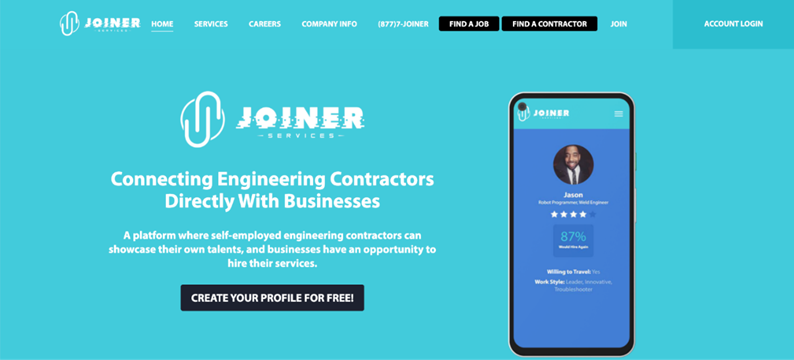
JOINER Services works this way. Businesses filter contractors by technical skills, experience, job title, location, availability, and star rating, then compare the shortlist before contacting anyone.
Profiles carry information a resume cannot. Contractors clear screening that includes reference checks, educational background verification, and interviews.
After each project, the client rates the work on 10 questions, records whether they would hire the contractor again, and confirms which technical skills were used on the job.
They work in the industrial manufacturing and automation fields, covering the roles that keep plants running:
- Weld engineers and Certified Welding Inspectors
- Controls engineers and PLC programmers
- Robot programmers and automation technicians
- Electrical, design, and manufacturing engineers
- Process engineers and quality engineering specialists
- Program managers
Their skilled workforce sits under one provider at standardized rates, drawing on a network of more than 1,200 contractors, so contract labor stops arriving from four vendors at four different rate structures.
You also interview your shortlist with your own engineering team before committing, which keeps the technical judgment where it belongs. For a hard engineering role, that beats trusting someone else’s definition of top talent.
Use it when: The work is project-based and industrial, and you want to see exactly who is coming before you commit.
Staffing a launch, a retrofit, or a shutdown? Create a free Joiner Services business account and compare engineers by skills, experience, availability, and client feedback before you contact anyone.
Outsourced Engineering With A Statement Of Work (SOW):
Rather than supplying people, the provider delivers an outcome: a design package, a validation study, a control system, a finished product. You buy the result, defined by the agreed-upon SOW.
Responsibility shifts with it, though how far depends entirely on the contractual agreement. The provider staffs the work, and the SOW sets who carries schedule risk, work, and change requests.
That is worth negotiating carefully on advanced manufacturing cells, new manufacturing processes, or the construction and installation phase of a plant expansion.
The catch is knowledge transfer. When the deliverable lands, the understanding behind it often leaves with the vendor, so build documentation and handover into the scope from the beginning.
Use it when: The deliverable is well defined, and you would rather buy the final product than manage the people it takes to do it yourself.
Recruitment Process Outsourcing And Managed Service Programs:
These are services for companies hiring engineers at volume. Recruitment process outsourcing (RPO) hands part or all of your permanent hiring to a provider, effectively taking technical recruitment off your team’s plate. A managed service provider (MSP) does the same for contingent labor, coordinating the agencies you already use.
Both make sense when engineering hiring stops being occasional. Once roles open continuously at several sites, the problem is process rather than sourcing, and a program fixes reporting, rates, and compliance at once. For occasional hiring, the setup cost is hard to justify, and a direct relationship with one or two specialists serves you better.
Use it when: Hiring runs continuously, and the mess is in coordination rather than candidate supply.

Software Solutions: Running The Process
These tools do not supply engineers in the same way as a staffing provider. Instead, they organize or support the hiring process you already run.
Applicant Tracking Systems:
It is a system of record for hiring. Job postings, applications, interview notes, offers, and compliance data live in one place instead of six inboxes. For engineering hiring, the value sits in structure. A scorecard asks every interviewer about the same technical skills, and a rejection note can be reread a year later when a similar engineering job opens.
Consistent records also make group decision-making faster, since nobody is arguing from memory.
Use it when: You hire regularly enough that spreadsheets are losing candidates.
Sourcing And Matching Software:
Tools that search beyond applicants, scanning professional networks and resume databases to surface passive talent, then rank matches against your requirements.
They work best for roles with clean job descriptions, like software engineering, where skills appear as named technologies. They work less well when the real requirement is judgment, such as knowing why a weld failed in the field rather than in a lab.
Use it when: Your bottleneck is finding people at all, not choosing between them, which is common on digital transformation initiatives where technical teams scale quickly.
Vendor Management Systems:
A vendor management system (VMS) is a cloud-based platform for procuring and managing contingent labor end-to-end. It handles requisitions, vendor selection, time and expense tracking, invoicing, compliance, and reporting in one system.
If contract engineers come through four agencies at four rate structures, this is where the mess gets sorted. It also gives finance a real number for contingent spend, which spreadsheets rarely do. A VMS is software that can help. It manages the vendors you have and does not find engineers on its own, which is why larger programs pair one with an MSP.
Use it when: Depending on whether the spend is large enough that visibility and compliance matter as much as filling the role.
Skills Assessment Platforms:
This is a structured test that puts a number against technical ability before an interview. Coding assessments are the mature end of this market, and engineering-specific assessments cover CAD, controls logic, and standards knowledge.
Used well, they cut the shortlist and reduce arguments. Used badly, they screen out experienced engineers who solve problems differently from the test author, so treat results as one input rather than a gate.
Use it when: Volume is high, and you need a consistent first filter before your engineers spend time interviewing.

Matching The Solution To The Situation
Most hiring managers already know their constraints. Below, I list some of the common ones:
- Inefficient production line: Use an agency with someone already on the bench, or a platform where you can see who is available and start calling immediately. Either way, it will include interviewing and onboarding, so ask for realistic arrival dates rather than promises.
- Nine-month capital project: Contract staffing or a platform, depending on whether you want to choose the individuals.
- Open permanent position: Direct hire, contingency for common roles and retained for scarce ones.
- Defined engineering deliverable: Outsourced engineering under a statement of work.
- Continuous hiring with limited spend visibility: An MSP for the people, a VMS for the data, and an ATS underneath both.
Two rules cut through most of the noise. Match the timeline to your project goals. Then match the specialization. A generalist firm will fill a engineer role more easily than a specialized role. Finding a partner who has market knowledge of the engineering sector you’re in, will really help you find qualified engineers in your sector.
Where The Money Actually Goes?
Cost comparisons between these categories mislead, because they measure different things.
Direct hire is a one-time percentage of salary. Contract engineering is an hourly rate that stops when the work is done. Software is a subscription whose payback depends on how much hiring runs through it. Outsourced delivery is a project price with the risk priced in.
The number that rarely appears on any invoice is the cost of leaving the role open. A stalled commissioning schedule, a delayed launch, or an unresolved quality problem can exceed the difference between a 20% placement fee and a contractor’s hourly rate.
Replacement demand keeps that pressure on. The Bureau of Labor Statistics projects about 174,800 openings a year in architecture and engineering occupations through 2035, most of them created by people leaving the field rather than by new positions [1].
That is the quiet part of the staffing problem. Even flat headcount means refilling engineering roles every year, and each one carries the same category choice.
Put The Right Engineers On The Project With JOINER Services!
Most engineering hiring problems are not really sourcing problems. They are timing problems, and every category listed above trades speed against certainty differently. JOINER Services is built for the fast end of that trade. You search screened engineering contractors, see who is available now, read what previous clients said about the work, and interview your shortlist before anyone starts.
They provide a better route to top engineering talent than writing a job description and waiting on a job board. You get to view a list of candidates, see their ratings and the verified skills upfront. This lowers the odds of discovering a technical gap two weeks into their assignment.
JOINER Services covers the work that keeps plants running! They provide controls, robotics, welding, electrical, design, and program management, on contract terms with standardized rates.
Have a launch, a retrofit, a shutdown, or just need a person for a few months on a project, not a full-time employee? Find a contractor now and compare engineers by skills, experience, availability, and client feedback.
Not sure which model fits the project? Contact the JOINER team for a free consultation and work through the scope before you commit.
FREQUENTLY ASKED QUESTIONS:
Below, I list some FAQs about engineering talent solutions.
Data Resources:
- US Bureau of Labor Statistics – Architecture and Engineering Occupation https://www.bls.gov/ooh/architecture-and-engineering/